We are a small and friendly group who have been carrying out excavations in the park under the supervision and guidance of professional archaeologists.
We carried out our fourth community dig in the area around the castle mound in July 2024. The dig took place over 2 weeks and you can read about the experience in the article below.
We are now starting to think about planning our next dig which is likely to be in September 2025. We will looking for volunteers to assist in a variety of roles including:
- hand excavation to find out what lies beneath the ground
- recording of archaeological finds
- cleaning and processing of finds
- research and field work to identify possible locations to excavate
- carry out the recording of the excavations and assist in preparing a report of the work carried out.
If you’d like to be involved from an early stage, please email us. No previous experience is necessary, training will be provided.
If you would like to be added to our mailing list please email: archaeology@friendsofcastlepark.org
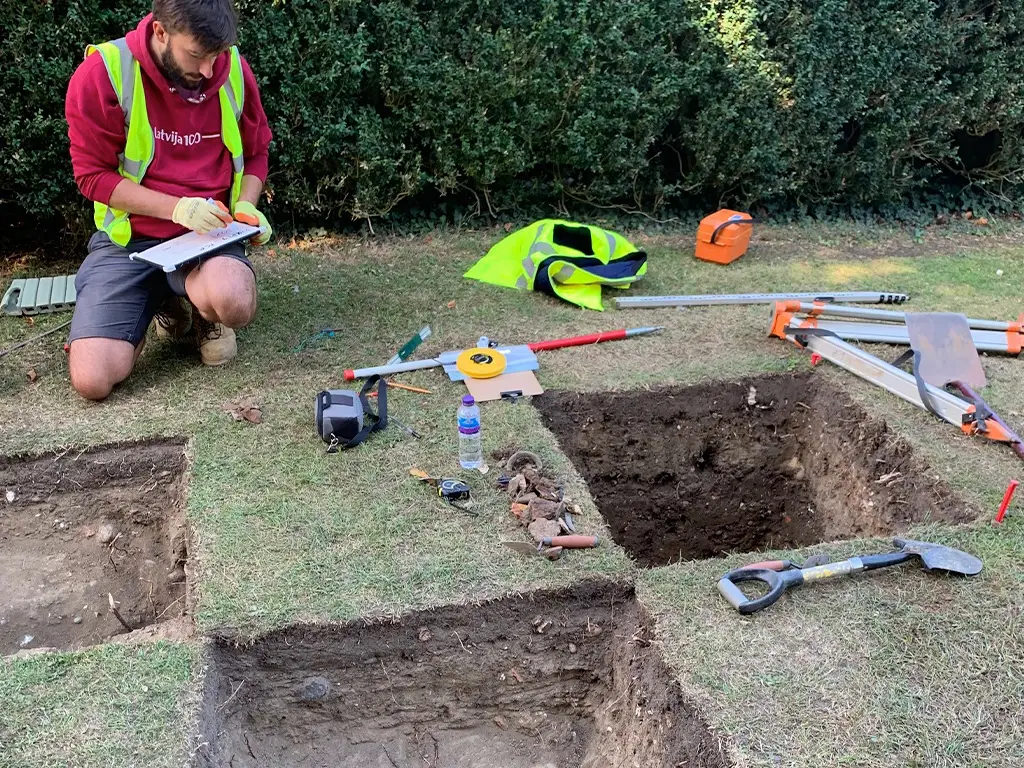
Report of a Community Dig in Castle Park August 8-19 July 2024
A community dig at Castle Park in Bishop’s Stortford took place at the beginning of July this year.
This was the fourth dig that volunteers have been involved in since 2019.
Previous digs had uncovered evidence of occupation since mediaeval times and revealed features that appear to be connected to the castle mound . They had also revealed that when the gardens were constructed in late Victorian period, a significant amount of soil mixed with rubble was used to level the ground.
The 2024 dig differed from the three previous ones in that the volunteers themselves took on much of the responsibility for planning and organising the dig, which previously had been carried out by the council and professional archaeologists. This was quite a steep learning curve for the small band of organisers.
Extensive publicity was carried out with a stall on the town market signing up nearly 50 potential volunteers. Social media, newspaper coverage and an open evening explaining what the dig hoped to achieve, generated further interest. Volunteer “slots” were made available using the Eventbrite platform and were quickly filled. 60 volunteers (in addition to the core team) took part in the dig; either excavating, washing finds or carrying out recording work. This was a significant improvement from previous digs and everyone involved was delighted by the community response.
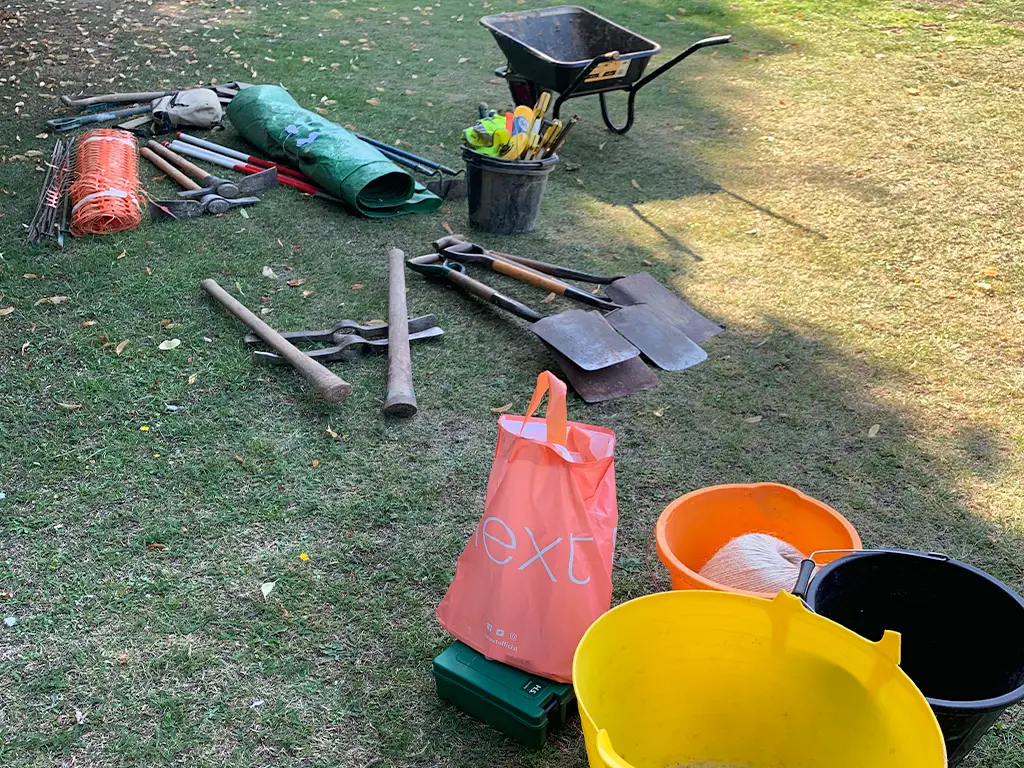
Other work was required beforehand such as risk assessments, ordering fencing and equipment, however, with support from the Stansted office of Museum of London Archaeology (MOLA) and East Herts Community Engagement Officer Kate Adam, all necessary preparations were carried out in time for the dig to start on the Monday morning.
Two areas were identified by the team as worthy of an investigation. The first was a trench, approximately 10 m x 2 m that was situated adjacent to where previous digs, which had revealed mediaeval evidence, had been carried out. We also planned to investigate a change in the soil that had previously been identified from an area of gravel to one where none was present. It was hoped that the trench would be able to establish whether the gravel layer was man-made or natural.
The other area was located on top of a possible feature that had been identified through geophysical investigation. This suggested there might be a z-shaped structure that could be walls or a building.
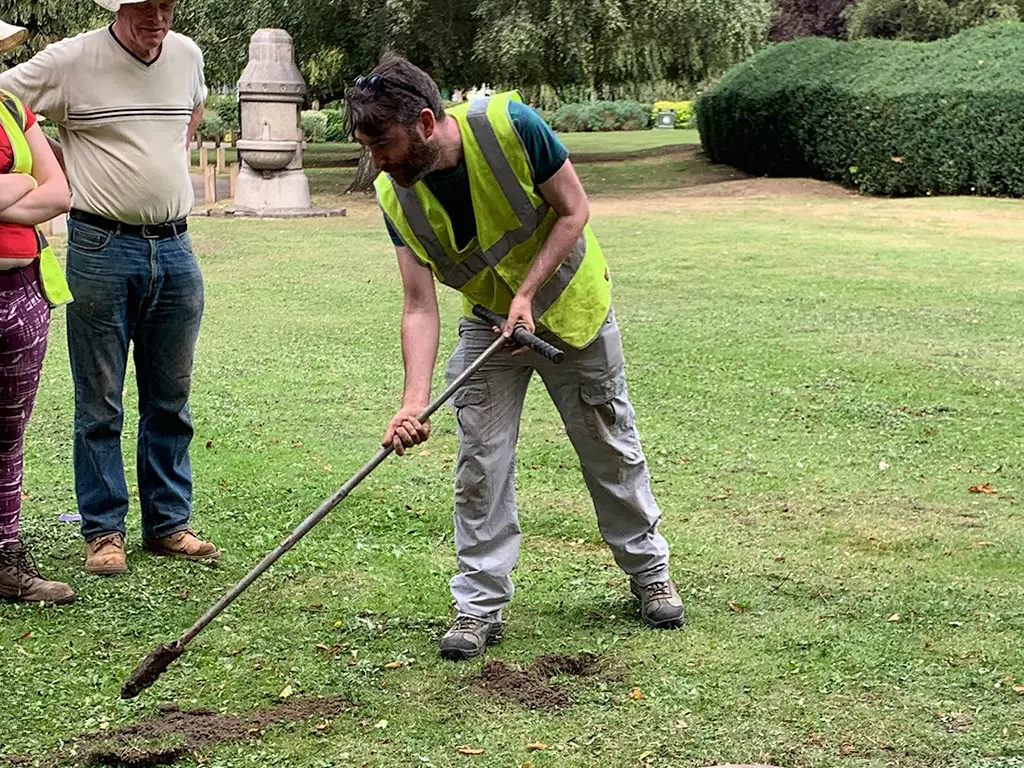
In trench one we initially opened up half of the planned length and were initially faced with a very modern deposit of soil and rubble that had evidently been laid as part of the recent park redevelopment. Such things as fencing brackets, supports and modern plastic were found in this layer. Digging continued through varying weather, including a torrential downpour on Tuesday afternoon that sent the volunteers scurrying for shelter.
Wednesday morning revealed the pit filled with water, however, very quickly using buckets and sponges we were able to dry out the trench enough to continue digging. We then hit the expected Victorian layer. This included vast amounts of roof tiles, significant amounts of oyster shells and other assorted glass, crockery clay pipe and building materials as well as two large patches of closely deposited large flints.
Once this has been excavated, we reached another layer that we believed to be natural.
By this time, we were nearly a metre down so we dug a small sondage at the end of the trench to confirm our suspicions. Brief excitement was caused when an animal bone was found in the sondage. However, under the guidance of our professional archaeologist Tee Edmonds from MOLA, we concluded that there was rooting activity that had gone down into this layer and the bone was within the rooting activity. Unfortunately, due to time constraints, we were unable to excavate the other half of the trench and hence we failed to reach the gravel layer.
In the other trench, we quickly came down onto a significant piece of flint construction that appear to be situated within the Victorian rubble layer. Work carried on to uncover this throughout the two weeks The construction didn’t appear to be “in situ” and our thoughts, at this stage, are that it was possibly a piece of the keep that had tumbled down from the top of the mound and subsequently been buried when the gardens were constructed.
We estimated that we dug out 15-20 tonnes of soil and then backfilled it, all by hand. Next time we’ll certainly try to arrange a machine to help out!
Overall, there was a little disappointment that we had failed to uncover any evidence of mediaeval occupation during this dig. However, this event must go down as a huge success in terms of the number of volunteers taking part, their enthusiasm and also the interest taken by the wider community (passers by, local press and social media). We hope we have established a much wider volunteer base for future excavations.
Funding for the community archaeology in Castle Park was provided as part of a National Lottery Heritage Fund bid associated with the redevelopment. This has now been exhausted and the Friends of Castle Park Archaeology Group must now explore other means of funding future work.
We plan to produce a report of the community excavations soon and hope to be excavating in the park again next September. We are also considering other activities that may draw in families and younger people.
Thanks are due to the “core-team” (Sue Harris, Margaret Hutt, Mike James, Mark Ratcliff, Graham Thompson, Roger Willmot), all our volunteers, East Herts District Council, Bishops Stortford Town Council, Countryside Management Services, National Lottery Heritage Fund and MOLA-Stansted. Particular thanks to Tee Edmonds (MOLA-Stansted) and Kate Adam (EHDC Community Engagement Officer).
Mark Ratcliff
If you would like to join our next community dig please email: archaeology@friendsofcastlepark.org